Showing posts with label history. Show all posts

Tuesday, January 22, 2008

What Shall We Call Our Women?: An Observation from T.T. Eaton


In a widescale attempt to provide lesser known blogs with good publicity, the honorable Owen Strachan has linked my blog with the notatable description: "history." I have to admit that while historical reflection was the reason I started this blog, my recent posts haven't exactly lived up to that vision. That said, it's time I started getting back to the basics. So without further a-doo-do...

I was digging through Boyce Centenntial Library's T. T. Eaton Papers today when a particular essay caught my eye. This Eaton essay was entitled: "What Shall We Call Our Women?" Eaton was a unique man of Baptist history, described by Russell Moore as "a man of the church who stood athwart history, yelling, 'STOP,' with a Bible in his hands." I also heard it said that Eaton represented simultaneously both what was right and what was wrong with 19th century Southern Baptists. If that is the case, then surely this essay represents all that is right and good! This man had an uncanny talent for observation and unintentional wit as evidenced to this very asute point that would have otherwise escaped my attention.

Eaton lamented the fact that Americans had no good formal title with which to refer to the bone of Adam's bone and the flesh of Adam's flesh (aka: the woman). Most cultures divide women into two classes: married and unmarried. In English, the married woman is known as a "Mizzez" (note the hard pronunciation), while the unmarried woman is referred to as a "Miss."

First, Eaton took issue with the appropriateness of "Miss" when referring to a single woman. Webster's Dictionary, of course, defines "miss" with such undesirable connotations as "a failure to hit the desired mark." Clearly, as Eaton suggested, this is not the sort of implication we should convey to our young, single women! As if to add insult to injury, the "miss" stem is often used as the base of many unpleasant compound words such as "mistreat" or "misunderstand."

Eaton, upset that even "Mizzez" sounded too gruff and unpleasant an honorific for the glory of man, conceded that other cultures have bested the English language in their formal references to the fairer sex. German uses the dignified distinctions of "Frau" and "Fräulein." French makes use of the magnificent terms, "Madame" and "Mademoiselle." Spanish uses the sweet sounding "Señora" and "Señorita." But English, that great universal language, can only muster up the unpleasant "Mizzez" and potentially embarrassing "Miss." America, according to Eaton, possessed a superior sort of women to any of these forementioned cultures, yet it rewarded them with the least attractive honorifics.
What then shall we call our women? I don't really know what Eaton would have recommended, as I did not have time to finish the essay and couldn't run off a copy since it was a manuscript from the library's special collections. But I suppose we are all captives to our culture at some point.

With great indebtedness to our late Brother Eaton,
I am,
On the Shoulders of Giants

Wednesday, August 29, 2007

"Strict Communion Less Exclusive than Paedobaptists?" or "Should the Water Divide Us?"


The Open Communion VS. Strict Communion debate has once again enticed a generation of Baptists holding to competing views. The question is an old one, "should our churches invite all Christians to partake of the Lord's Supper or just those who have been baptized?"

The open communicant answers, "All Christians should be invited to partake of the Lord's Supper."

In contrast, the strict communicant (under which I include both "close" and "closed," though I disagree with the latter) answers, "Only those Christians who have obeyed Christ and have been properly baptized (baptism meaning "immersed as a believer upon profession of faith") may be invited to take the Lord's Supper." This sort of answer immediately brands persons of this persuasion as exclusive, divisive, and more committed to ecclesiasticism than Christian love.

For the sake of putting my cards on the table, I confess I lean closer to the strict communion tradition.

This nuanced debate is unique to Baptists, as far as I can tell. Baptists are concerned about how to treat a Christian of another denomination if he should attend a Baptist worship service in which the Lord's Supper is being served. Is excluding him from the Lord's Table equivalent to an insult against his godliness?

The best argument I have heard on the subject is quite simple. I encountered it in John Quincy Adams' (not the U.S. president of the same name) Baptists: The Only Thorough Religious Reformers (1876).

To paraphrase Adams' argument:
1. In the New Testament churches, all who were baptized and members of the church were admitted to the Lord's table.

2. One considered a proper subject of baptism would never be excluded from the communion.

3. Baptists receive all proper subjects of baptism (i.e. believers who have been immersed upon their profession of faith).

4. Paedobaptists consider infants who are sprinkled to be legitimately baptized and members of the visible church.

5. According to this logic (of #4), all baptized infants should be admitted to the Lord's Table.

6. Yet, these infants are excluded, and thus the "paedobaptists are most inveterate closed communionists."

7. Paedobaptists have no argument against strict communion Baptists, who "refuse to receive persons whom we consider unbaptized, when they will not receive their own baptized members."

John Quincy Adams, Baptist thorough Reformers (1876), Reprinted: Rochester, NY: Backus Book Publishers, 1982, 160-161.

Solid paedobaptists and the like all believe that no one should be admitted to the Lord's table without being properly baptized. I find it ironic that on this particular point, strict communion Baptists agree with them 100%. The disagreement is on what constitutes a proper baptism. At the risk of sounding cliche, I suppose it all depends on what your definition of "is" means.

Friday, August 24, 2007

Speaking of the Dead (in Christ)

Speaking of the dead... I'm finally getting around to updating my blog!

The title of this entry carries a double meaning.
There are a number of reasons I have cut my blogging back to a minimum these days. One is that I have a very slow computer that always eats away more time than I can spare on little exercises like blogging. Another is that my brain is low on creative impulses. But the biggest reason is that I am trying hard to bridle my tongue so that I won't write something I might regret later. I believe blogging is a good thing, but I'm trying to mortify a few areas of my life that need more discipline.

One important reminder in this struggle occurred a few months back when I forgot the important fact that what one writes on the internet doesn't always communicate as well as a face to face conversation.

I left a mildly sarcastic comment on a blog in response to something another commenter had written. I'll spare the names of all parties involved, but the gist of the exchange was:
Commentator: "Was [said theologian] fat? I like fat theologians!"
Me: "Yes, and skinny theologians everywhere are offended. :-)"

At the time, I did not think my comment was rude or disrespectful.
A few weeks later, however, a respected mentor of mine came across the same blog and noticed my comment. He confronted me about the matter, and ,while not expressing any explicit signs of anger, challenged me to consider whether such a comment displayed appropriate respect to the legacy of this particular glorified saint. As a result of this conversation, I realized that my statement was careless if not intentionally disrespectful.

I was challenged with the concept of speaking of the dead in Christ as if they are still alive. In a very real sense, of course, they are. As Hebrews 12:1 reminds us, "Therefore, having so great a cloud of witnesses around us . . . let us run with endurance the race that is set before us."

I want to be careful not to suggest anything akin to saint worship, but the Bible reveals that God's glorified people, faithful in life, faithful at death, now serve as historical testimonies to the grace of God. Their lives and ideas are not above criticism and godly evaluation, but they are all certainly worthy of our respect, no matter how prominent or how obscure.

So, as I continue to meditate upon the application of this truth, I conclude this entry with a deep appreciation for those who have tilled the soil in which I now labor.

I am,
On the Shoulders of Giants

Saturday, November 11, 2006

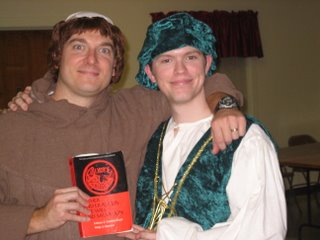
Luther and Erasmus: Together for the Gospel!


I know it's a little late, but I really like this picture of my pastor and I as Luther and Erasmus... Together for the Gospel!


http://thecroftfam.blogspot.com/2006/11/reformation-party-at-church.html#links

Monday, December 12, 2005

Santa Claus and the Christmas Myth


When I was about 13-years-old, I realized that Santa Claus wasn’t real. Imagine my surprise when about 3 years ago, I realized that he was.

Upon becoming a teenager, I first became conscious that things which have basis solely in tradition were foolish and not worth believing in or preserving. Mythological stories like a man named Santa Claus who leaves presents for children every Christmas Eve were not “real” because my definition of reality was dependent only upon things that have physical matter. I trust my mental prowess must have common to most young philosophers my age. Because we realized the impossibility of one man to fly around the world in a sleigh pulled by 8 tiny reindeer (and Rudolph on the foggy nights), we philosophers concluded that Santa Claus or any other fantastic idea of Christmas magic or myths is not a tradition worth believing in.

I grant that the evidence accumulated against Santa Claus’ existence cannot be ignored. There are confirmed accounts of houses that lack presents on Christmas morning (not even a lump of coal). There are eyewitness reports that the job of Mr. Claus has been filled by some well-meaning parents who don’t even bother wearing a red suit or cap whilst practicing their deception. Most parents will probably admit that Santa not only leaves presents under the tree, but also sales receipts in their wallets. But I believe it is folly to conclude that Santa Claus does not exist based upon the fact that he is not acknowledged in some homes.

In 1897, a little girl named Virginia wrote to the editor of the New York Sun asking if it was reasonable to believe in Santa Claus when all her friends told her it was foolish to do so. The editor responded by writing that indeed it was not only tolerable to believe in Santa Claus but encouraged her to do so. He explained that her friends had been “affected by the skepticism of a skeptical age.” The same words could have easily come out of the mouth of C. S. Lewis, who was fond of mythology even before he ever came to faith in Christ or wrote his Narnia books. But as a young man, Lewis had once renounced any notions of faith or mythology in favor of atheism, skepticism, and materialism. Many years later, in Surprised by Joy, he reflected upon this time of his life and remarked: “Nearly all that I loved [poetry, beauty, mythology] I believed to be imaginary; nearly all that I wanted to be real, I thought grim and meaningless.”

C. S. Lewis the atheist wanted to believe in myth and meaning, but he couldn’t because he thought that reality must be defined in terms of the physical or material alone. Myth is imaginary and is therefore not “real” as he then understood it. Lewis sought for meaning and beauty, but his struggle was only resolved when he was persuaded that Christianity was the one true myth. Indeed, it was “the true myth to which all the others were pointing,” and it alone “was a faith grounded in history.”

As I read The Lion, the Witch, and the Wardrobe and then watched the new movie, I was struck by the scene where the professor rebukes the skepticism of the older children who disbelieve their little sister’s claim that she visited Narnia. Alas, Peter and Susan had unconsciously bought into the secular ideas of skepticism which the editor of The New York Sun warned young Virginia about. I think most children fall prey to this skepticism around the teenage years due to the secular rationalism that says that whatever forces or beings that cannot be seen must not be real or worthy of admiration. I have many brothers and sisters in Christ who do not believe in the myth of St. Nicholas; some even accuse it of being the root of the greed and materialism that might be considered a 21st century version of Turkish delight. Some say that Santa Claus, Christmas lights, and Christmas presents distract from Jesus’ glory, and I doubt if anything will alter their thinking.

But the myth of Christmas tradition and the true meaning behind Christmas need not be in opposition to each other. I recognize that difference between the Incarnation of the Son of God and the myth of St. Nicholas. The gospel of the Christian faith has its basis in fact (making it the true myth), while the contemporary myth of Santa Claus has its basis primarily in tradition. The myth of Christmas can be traced to the charity of a real bishop who gave money to young women to aid them in marriage. His example reminds us of God the Father’s gracious gift of His invaluable Son to us when we did not deserve Him. As we celebrate the spirit of Christmas by continuing the example of St. Nicholas, we remember that any gifts we receive are but reflections of the Greatest Gift we mercifully received from the Great Giver. Christmas presents given to us in the name of Santa Claus are valuable only so long as they help us in our gratitude to the Father and our joy in the Son. If they become the chief end of the holiday, then the Christmas myth becomes meaningless and idolatrous. But when the Christmas myth points us to the True Myth, then we can rejoice in the truth while being appreciative of the traditions that supplement but never supersede it.

Merry Christmas to all and to all a good night!