Showing posts with label church. Show all posts

Saturday, April 25, 2015

Sermon & Illustration

This past Sunday, I got my first opportunity of 2015 to preach at my Louisville home church.  The requested text was 2 Timothy 2:8-13, which is one of the New Testament passages designated as a "trustworthy saying," the other three being 1 Timothy 1:15, 1 Timothy 4:8-9, and Titus 3:4-8.  The message can be streamed or downloaded at the church's website:
"When the Blessed Assurance is Your Only Assurance" (April 19, 2015)
http://www.auburndalebaptist.com/sermon/when-the-blesses-assurance-is-your-only-assurance/

I hold to the full inerrancy of biblical inspiration, so I believe that the totality of the Scriptural canon is equally inspired by God and profitable for doctrine, reproof, correction, and instruction in all godliness.  That said, when the inspired apostle Paul writes to Timothy and explicitly calls attention to a particular idea as a "trustworthy saying," we ought to take special note.  Paul identifies passages like these as something that we should strive to internalize into our hearts so that we can recall it with speed and ease when we need those words the most.  These type of promises are the ones that we ought to turn to when we are struggling with the trials and tribulations of life.  That's one of the themes I focused upon during my sermon.

Reflecting upon this text during my preparation led me to consider the parallels in this "trustworthy saying" and the Christian hymns we so often sing in worship. My favorite hymns are those that convey edifying biblical truth in a manner that is especially memorable enough to stir the affections of the heart.  Most of the classic hymns feature a common refrain (often the chorus) that unifies thematically the unique lyrics of each verse.  The individual hymn verses--though diverse in their wording and emphases--aid the singer's understanding of the unifying "big idea" theme by teaching development of the main idea and even providing an example of application across various circumstances.  Even when I forgot some of the words to a particular verse (as I am prone to do), I know the chorus by heart well enough to look away from my hymnal's text.

I think Paul is doing a similar thing in his instruction to Timothy in this passage.  By the time Paul wrote the letter, he had experienced perhaps the most traumatic experience of his entire ministry.  Unjustly imprisoned, he stood alone at his legal defense, isolated from the love and support of his former partners in ministry.  So as Paul passes on wise counsel to young Timothy, he sums up the heart of his message in these poetic, hymn-like words:
For if we have died with Him, we will also live with Him.
If we endure, we will also reign with Him.
If we deny Him, He will also deny us.
If we are faithless, He remains faithful...
For He cannot deny Himself.

Each of these verses carries a distinct emphasis, but the unifying chorus is that trusting in the promises of God through Christ is what gives us assurance and motivation for our endurance of the difficulties of life.  This is a truth Paul never forgot; even in his darkest times, he learned to cherish it all the more dearly.  I trust the same became true of Timothy.  I pray that the same might be said of me and you.

I've been blessed with opportunities to deliver many sermons over the past two years, but this is the first time I've had anybody translate my delivery into the artistic medium.  So far as I can remember, the little dots at the bottom of the picture are an accurate representation of the folks who sat in the first few pews for the service.  It was also a Lord's Supper Sunday night, so the bread and juice are on the table at the foot of the pulpit.

Artistic Credit to Draven Cheatam

"I have stored up your word in my heart, that I may not sin against you." Psalm 119:11

Saturday, March 16, 2013

Teaching Kids about Hating Sin (aka, Lessons from a Ten-Year-Old's Testimony)

I've been teaching children's Sunday School at my church for nearly seven years, and that responsibility carries its own unique joys and frustrations.  I've been privileged to serve with four different co-teachers throughout process who helped to compensate for my own shortcomings.  I consider myself blessed to have had an opportunity to influence these kids with the Gospel message for so long, but there are many times when I question my own effectiveness in trying to help these children understand the gravity of what it means to be a sinner in need of salvation in Christ

Almost all of my regular attenders have the remarkable benefit of loving parents who are strong Christian leaders and ensure that the whole family is at the congregational gatherings every week, yet not all of these children have experienced God's saving grace and committed their lives to Christ's service.  Therein lies my greatest challenge as a teacher; how can I plant some spiritual seeds in the hearts and mind of these precious but naive little sinners that God might one day grow into genuine faith?  It's not like God needs my participation in His plans, of course, but I do believe that there's a divine purpose for which I've been given the privilege of teaching these kids for a season of their lives.

One theme that I routinely emphasize to the children is that they need to recognize the fact that they are all sinners who are personally guilty of breaking God's commands.  So I'll often ask each child about their own personal acts of disobedience to parents or sins of that nature.  That's when things usually get interesting.  Lying, theft (from siblings), anger (again, usually directed towards their siblings) or hiding the truth tend to be the most frequent confessions I hear.  The kids can easily recognize the fact that they are sinners and even agree that they deserve punishment when they are caught in their offenses. But very few of the kids ever seem to be visibly upset and sorrowful about their sins and offenses, and that's been one of the causes of my frustration over the years.  I'm not content with the kids merely recognizing that they are sinners; I want them to hate their sin and run to Christ for rescue.  I can't make that change happen, but I hope that I can at least communicate the importance of that message.

There's a lot of spiritual advantages to being a child, as Jesus taught us in Matthew 18:3.  Their minds are usually more adept at having faith and in believing in miracles compared to most adults.  And most children haven't had as much time or opportunity to commit grievous sins that can harden the heart against God.   But there are probably spiritual disadvantages to being a child too. I think the inherent naivety of children can make it difficult for them to truly hate their sin for its own sake.  They might hate the punishment that befalls them because of their sin when their parents discipline them, but that's not the same as hating sin.  In order for them to truly understand their need for Christ as Savior, they need to understand how bad sin is... even the relatively "small" sins that they've committed in their short lives.  And it's at this point that I yield the stage to a remarkable testimony composed by a little girl.

Nearly a year ago, one of the ten-year old girls in my class came to Christ and was baptized.  With the help of her parents, she composed a written account of her testimony and the event that finally made her come to hate her sin and put her trust in Christ.  In my opinion, it's one of the best Christian testimonies I've ever read because it displays that rare recognition of how terrible sin is and why we should despise its existence in our hearts.  And the story all started because she was thirsty and decided to lay claim to the last Gatorade before her brother could get to it.

In her own words:
One day me and my brother had our practices, and there was one Gatorade left. I wanted it so I took the Gatorade and started to write my name and draw pictures on it so that I could have it and so no one else could take it.  After I stuck it in the fridge God showed me my heart and showed me that what I did was wrong and that I was being selfish for wanting and taking the Gatorade.  So then I took a note and I wrote, "I'm sorry for taking the Gatorade I feel so selfish just taking the Gatorade please forgive me."  And after I gave my brother the note and the Gatorade I felt like I loved God more than I ever have and I wanted to learn more about god and his word. 

Nearly a year later, I still read those words with amazement.  That ten-year-old girl didn't commit any great moral offense, and I doubt she even would have been punished by mom & dad for taking possession of that drink.  But she realized that the key issue was her own heart, which was selfish and didn't trust God.  And that's the realization that spurred her spiritual transformation.  After a talk with her mom, she was advised to admit she was a sinner and to trust in Jesus alone for salvation.  And then she wrote:
Then I realized that Jesus changed my heart. When I felt my heart change my dad and I read some scripture. One of them was Ezekiel 36:26: "I will give you a new heart and put a new spirit in you; I will remove from you your heart of stone and give you a heart of flesh." When I read this scripture I knew this is what I wanted God to do for me, and he did.

I have read many adult testimonies of how God changed hearts and rescued very sinful people out of some very terrible lifestyles, but I can't think of many that impart the same insight into human nature as this little girl's story does.  If we could all hate the small sins we commit against God and our Neighbor as much as she hated what she thought about doing with that Gatorade bottle, then maybe we could all start recognizing how awesome a work of grace that God does in our hearts when we come to Christ.

Thursday, November 08, 2012

The Most Important Votes I Cast This Week

"This is the most important election of our lifetime."

I can't even remember how many times I've heard that phrase since 2004.  I've voted in every presidential election for which I've been eligible because I believe it is both my right and my duty as a citizen.  To be perfectly honest, however, I have discovered that voting for a major political party candidate is emotionally comparable to picking a team for which to root in a sports game.  I don't want to belittle the importance of political issues by comparing them to something so trivial as athletic competition, but my emotions are about the same either way.  If my "team" wins the contest, I'll feel happy for a few moments before reality sets in and reminds me that very little lasting good will come out of said "victory."  Maybe I'm more glad to see "the other" lose than I am to see "my team" win, if for no other reason than that I don't have to watch other people gloat who don't see things the same way that I see them.  And if "the other" wins, I'll be disappointed and imagine the day when the scales might tip the other way.  Maybe I'll be optimistic about "next year" or maybe I'll realize that there is no guarantee that "my team" will even come close to winning a future contest.  When I wake up in the morning, I'll go about my real-life business much the same way that I always have.  "The sun rises and the sun sets, and hurries back to where it rises," to borrow a phrase from Ecclesiastes.

But on Wednesday night, in the basement of a little Baptist church in Louisville, Kentucky, I believe I cast four "votes" that have far greater consequences than a four-year cycle.  I joined my Baptist brothers and sisters (with whom I covenanted together nearly eight years ago) in adding three new members to our fellowship and removing one long-time brother through church discipline.  By the grace of God, adding new members to the fellowship is a frequent experience at our church, and it's always a joyous occasion to see what plans God has in store for the newly added brethren.  On the other hand, the disciplinary process is (thankfully) a relatively rare phenomenon, but one that is always painful.

In Matthew 16:19, Jesus promised to give the keys of the kingdom of heaven to His church.  There's been a plethora of diverse opinions as to just what our Lord meant when He said, "whatever you bind on earth shall be bound in heaven, and whatever you loose on earth will be loosed in heaven."  I don't claim to know all the details of the text's meaning, but I think everybody should agree that it at least affirms that the earthly deeds of the church have eternal consequences.  I believe these eternal consequences are on the line whenever a congregation convenes a business meeting in which they will decide who to admit into the fellowship and who to exclude from the fellowship.

If memory serves, I've had to cast four votes of discipline during my church-going life, and it's been a gut-wrenching feeling in every instance.  When I cast that vote to place my old friend under the discipline of the church, I did so with the sorrowful conviction that my friend no longer valued Christ as the Savior and Lord of his life.  I fear that all his joyful service over the past seven years was but a well-meaning deception... one that he himself may not even have been fully aware.  His sins against his family and his Lord were evident to all, and though my friend acknowledges his fault, he remains unrepentant.  In 1 Corinthians 5, Paul described the act of church discipline as the final, desperate act by which a church might see their sin-bound brothers brought to true repentance and reconciliation.  When the assembly of the church votes to discipline, it amounts to no less than a "deliverance to Satan" so that the man's eternal soul might ultimately be saved at the Lord's appointed time.  God is sovereign, but God uses His church as the appointed means by which people can prepare themselves for the inevitable Day of Judgement when only One vote matters.  In my experience, the disciplined brothers and sisters who respond in repentance are the exceptions to the norm.  In spite of that, we still ought to have hope that God will work mightily to recover the His lost sheep.

For me, political elections have been reduced to futile, half-hearted attempts to restrain sin and human depravity through legal tour de force.  I'm not ashamed to admit that fact, but I don't take pleasure in being a "single issue" voter who knows that even the best-case outcome is unlikely to change laws... let alone change hearts and minds.  It's like rooting for your favorite sports team of aging, overpaid players to make that one last run at the big trophy.  Even if they do manage to capture the championship, the odds suggest that they will lose the crown the next time around.

But when I take my responsibilities as a church member seriously, I have hope for more than simply restraining sin through Law.  I can believe that the Holy Spirit of God is working in and through the people of Christ to do a work of Grace.  When Grace changes hearts and minds, lasting life-change necessarily follows.

The most important "vote" of our lifetime wasn't in 2004, 2008, or 2012, and it won't be in 2016 either.  The more important votes are the ones we cast when we covenant together to prepare people for the Kingdom that is coming.  And that's a Hope that can truly sustain me.

Wednesday, December 14, 2011

Teaching Kids about Death and Resurrection

I posted previously about my first reactions to the recent death of my friend, Stacy Ellison. This is the follow-up story about how I went to church the Sunday immediately following his passing.

Despite my grief over the loss of my friend, I had to prepare a Sunday School lesson for three kids, ranging in age from 10 to 12 years of age. I chose the text of John 11:1-44, the famous passage where Jesus raises Lazarus from the dead. That text is an easy choice, since it so clearly gives Christians comfort with the hope of being raised from the dead ourselves. I was also hoping that these tragic events might make the threat of death a present reality to these precious (and mostly unconverted) little children with so much living yet to do (God willing). I prayed that if any good might come from these sudden deaths, it would be that it might awake unconverted souls to their need for salvation in Jesus.

For the sake of my emotions, I decided not to mention Stacy or his family directly during the course of the lesson. After reading through the biblical text with the kids, I proposed a three point summation of the passage:

1. Lazarus was a friend of Jesus.
2. Lazarus died.
3. Jesus resurrected him from the dead to live again.

I tried to make the kids aware of two facts. First, that the second point ("this man died") is a fate that awaits all of us assuming that Jesus doesn't come back first. And secondly, that the third point ("Jesus resurrected him") is dependent upon the validity of the first point ("He was a friend of Jesus"). My goal was to communicate to these children that if they want to have a hope in life beyond death, then they must be a friend of Jesus, which I chose to define as "Trusting in Jesus alone for salvation."

It's a message I had presented to these kids many times over the past five years, but that Sunday I emphasized it with greater passion than ever before. On account of the death of my relatively young friend of 37-years-old, I was conscious that none of us has any guarantee on how long we will have to live before that dreaded day of earthly death falls upon us.

In my previous post, I stated that the nature of Stacy's kind of "accident" unnerved me. Just two days earlier, a Texas pastor and his wife (Jackson and Barbara Boyett) who had been friends of our church also lost their lives in a head-on collision in which an oncoming vehicle slid into their lane. At the time, I tried to justify their deaths with arguments like, "I sure do know how dangerous those country highways can be. When cars reach high speeds and drivers get lulled into distraction, bad things tend to happen." And then I heard about Stacy's crash. Apparently it wasn't the result of cars traveling at high speeds and apparently it wasn't the result of a distracted driver. From what I've read, a the driver of a pickup truck moving across a busy metro bridge in a 35 MPH zone suffered a seizure, pushed down hard on his gas pedal, and slid across into an oncoming Ford Taurus, which my friend was driving. There's just no logical explanation for why Stacy was in the wrong place at the wrong time. It just seems like it was destined to happen. I don't know if there is any significance as to why these dear folks died the same way in such a short amount of time, but it felt like cruel irony. I felt like God was just trying to get my attention by saying "When it's your day to die, there is no avoiding it or explaining it away."

As I read through John 11, I was struck by the emotional rebuke that Martha appears to give to Jesus in verse 21. She said, "Lord, if you had been here, my brother would not have died." It's a subtle rebuke, but it's absolutely true. Jesus knew of Lazarus's ailments yet intentionally delayed a visit for two days promising that "it is for God's glory, so that the Son of God may be glorified by it" (verse 4). The human side of me wants to know what Jesus was doing that would have been so important. What human friend would sit around while his friend lay dying? What human father would intentionally delay going to help his suffering son? If only for an instant, Martha appeared to be angry at Jesus. Given the perplexing nature of the recent deaths of people connected with my church in Louisville, it was an anger with which I could sympathize... if only for a moment.

Yet, though Martha's faith may have been weakened with the death of her brother, it was still strong enough to confess that "I know even now that whatever you [Jesus] ask of God, God will give you." This was not a "health and wealth" mantra, but an expression in her confidence in the unbreakable union of Jesus and God the Father. Even though we may not always like how God's providential will unfolds in life, we have to trust that God works through all things for the glory of Christ and "for the good of those who love Him and are called according to His purpose" (Romans 8:28). It was an immediate rebuke to my own disappointment with God's providence over the past week.

Getting the focus back on the Sunday School lesson, I simply exhorted those precious little children to ensure their eternal destiny by putting their complete trust in Jesus to save them from their sins. In order to be raised from the dead, they needed to become friends of Jesus. As I thought of the grace Jesus had shown to Stacy, I thought also of the grace Jesus has shown to me in forgiving my sins and giving me a new heart. It was at this point that the emotions I had suppressed all weekend finally got the best of me. I had to hand over the remainder of the lesson to Matt Miller, my co-teacher, because I could only weep like small child who had just stubbed his toe on a door. Matt challenged the kids again not to delay matters of eternal salvation.

I genuinely hope and pray that the sudden deaths of the Boyetts and Stacy Ellison might give the rest of us cause to think more seriously about the salvation of ourselves and others. Ultimately, the most important question we have to answer is whether or not we're a true friend of Jesus Christ.

Saturday, November 11, 2006

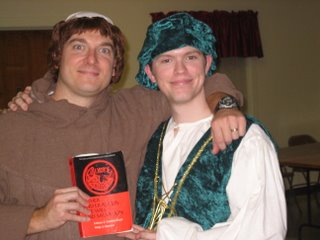
Luther and Erasmus: Together for the Gospel!


I know it's a little late, but I really like this picture of my pastor and I as Luther and Erasmus... Together for the Gospel!


http://thecroftfam.blogspot.com/2006/11/reformation-party-at-church.html#links